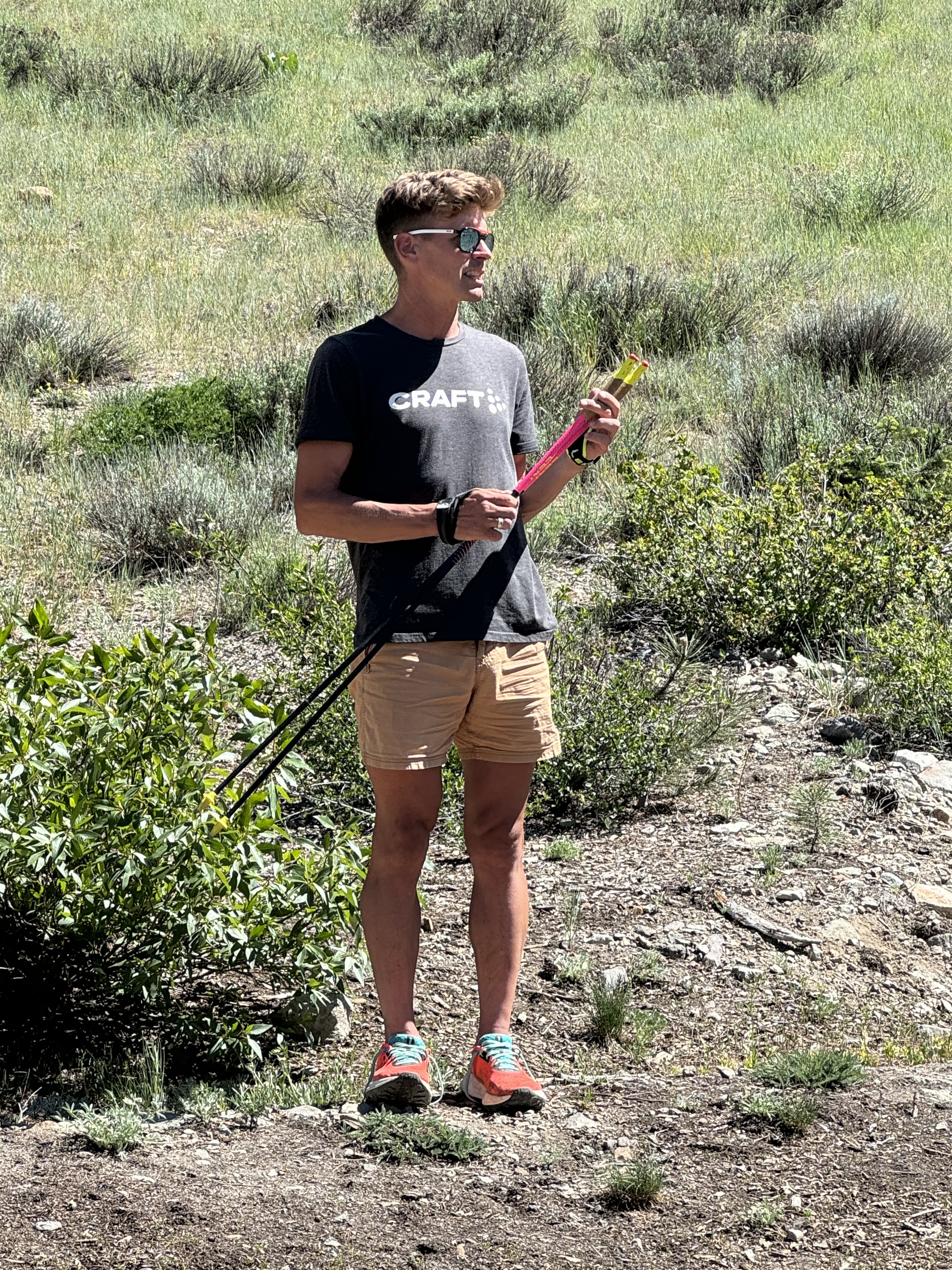
*Note: From a class with the pro-runner, stellar human, race director Tim Tollefson. Notes are solely from my menopausal memory from a 30 minute class; mistakes in content or descriptions are all mine!
As newly minted Hippy (full right hip replacement 4/11/23), I was told to get back to living life. I was also warned to not ‘pound on a downhill run/hike’ and if I wanted to keep doing other crazy mountain ‘things’ i needed to learn to use trekking poles for safety/stability and to be a little ‘gentler’ on the artificial hip.
Awesome! I’m getting fitness back, finding steeper/more technical terrain and slowly (OH SO FREAKING SLOWLY) progressing back to soft/gentle/FLAT running. It is past time to start using trekking poles; but I wasn’t sure exactly where to start to be honest.
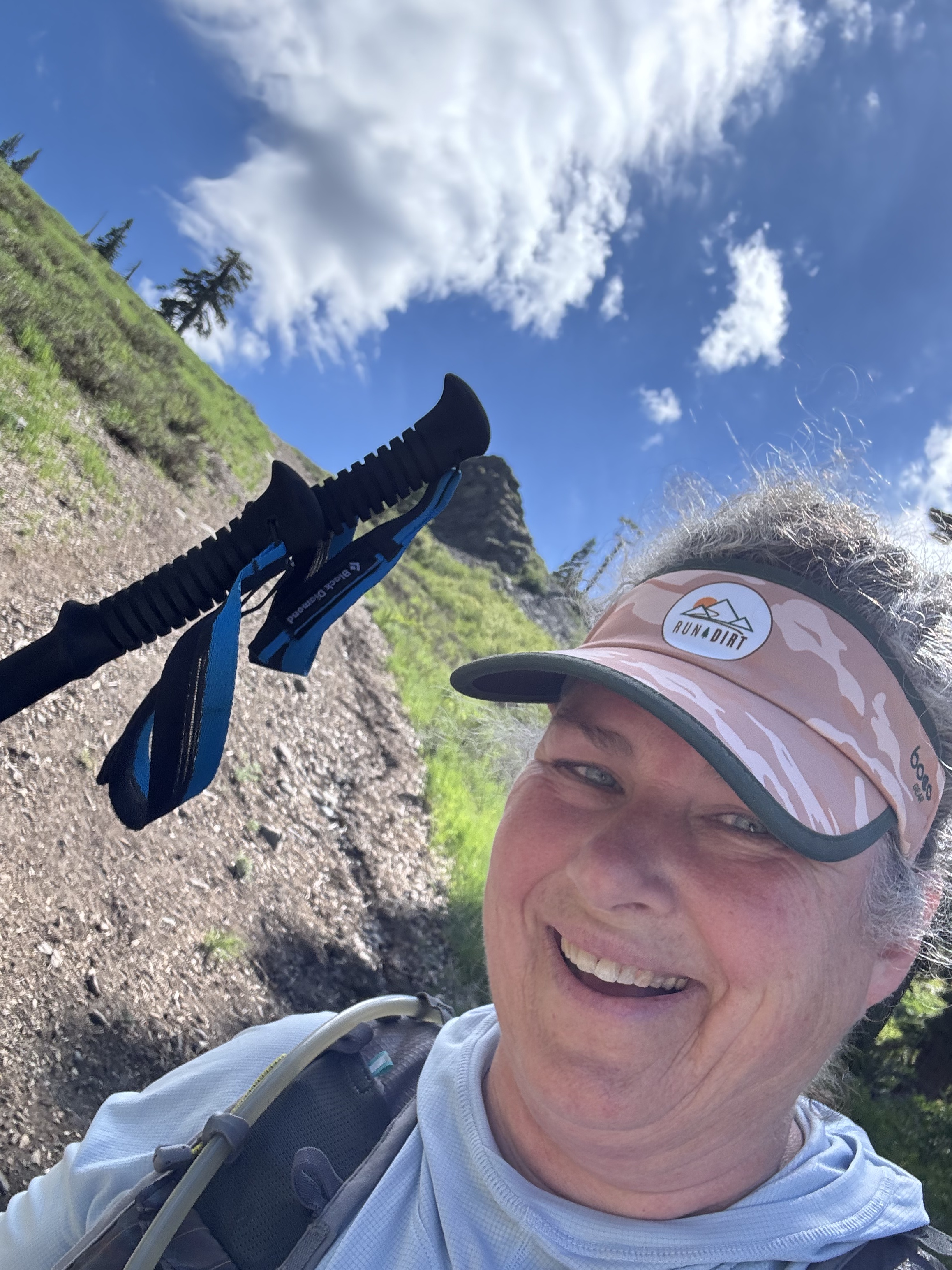
I have trekking poles. They’re nearly as old as my running career. 😂 I have used them inefficiently and inexpertly many times. They’re plain old awkward for the most part! Not one time have a finished a run or hike and thought ‘those helped!’ it is usually ‘why the hell did I carry those damn things the entire way?’.
Trekking poles for me have been part hazzard and part spectacle.
Post hip surgery I googled using trekking poles for hiking and trail running. Huge mistake. THERE are a zillion (or so) videos and a zillion (or so) matching/conflicting opinions about use/don’t use/how to use/when to use… I defaulted to my comfort zone when overwhelmed with conflicting info; I gave up. Figured I’d carry them around when I was on steep terrain, try to look like I knew what I was doing, hike down SLOWLY and only use them if things got dire.
That was my entire plan even when I was TOLD to use them to help my hip.
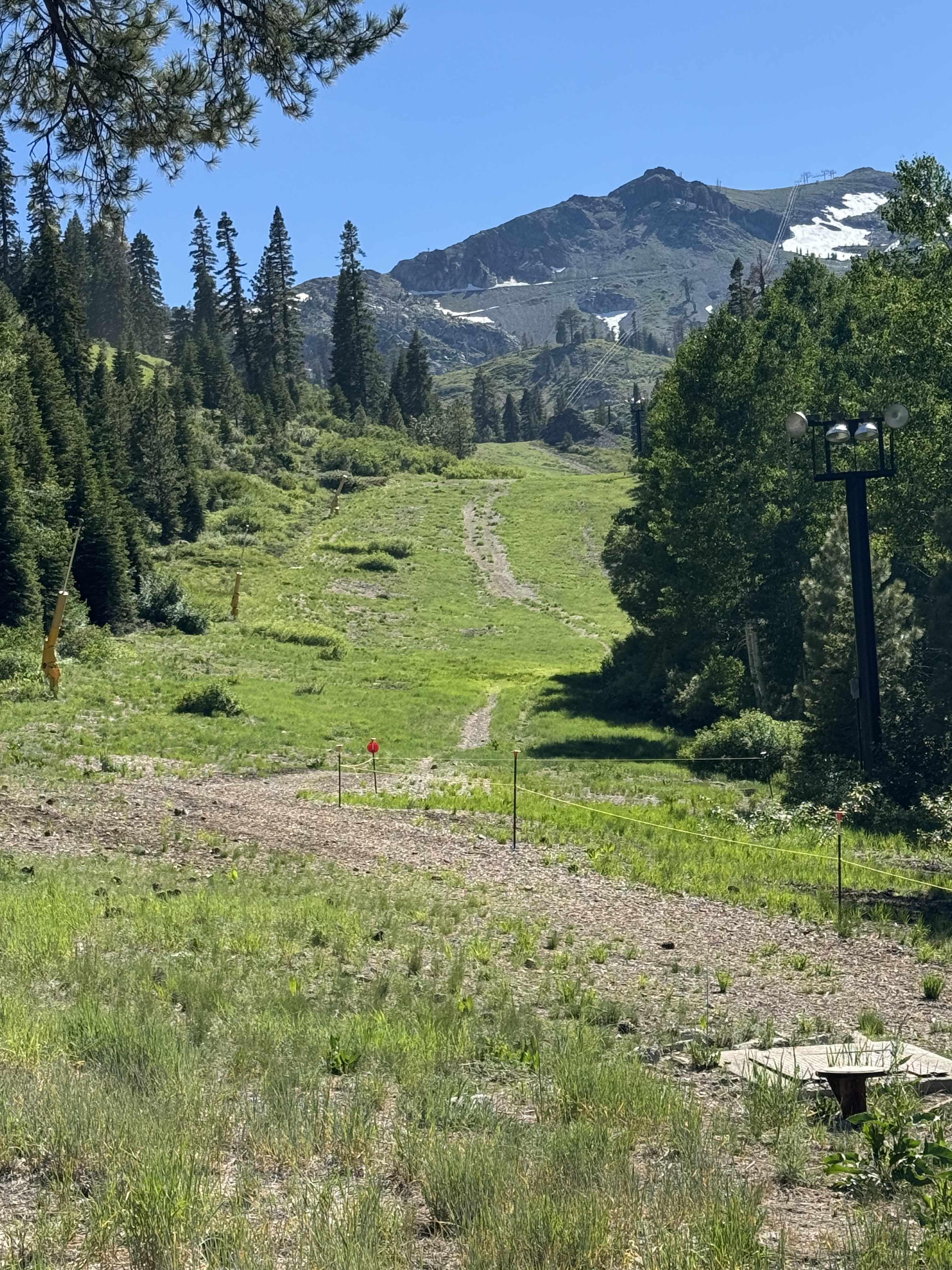
Fast forward to this week. I stumbled across a free Leki trekking pole class with pro athlete Tim Tollefson while I was volunteering at the Broken Arrow Skyrace in Olympic Valley, California.
So I signed up for the class.
Showed up. (Full disclosure; sometimes I chicken out of these things if I’m not keeping a good and healthy handle on the narrative in my head about being the fattest/oldest/slowest/not deserving. I’m in a good spot right now and easily shut those voices down pronto. I know I am not alone in possible barriers I place in my own way from time to time. And also I’m keen to share a win!)
I got sized for a demo pair of trekking poles.
And we headed for a steep sidehill and I LEARNED.
Holy smokes. I learned so much and was encouraged and inspired!
Sharing some of the highlights just in case anyone else is ‘pole’ curious and hesitant…
- PRACTICE. Using trekking poles is a learned skill. You have to intentionally practice with them as part of your regular training.
- Short of planting them both right in front of you and walking into them (I HAVE DONE JUST THAT… And I would bet I am not alone…) it turns out there really is no right or wrong. There’s better, there’s more efficient, there’s powerful – but really no right or wrong. I have hesitated using them assuming there was a right/wrong. Not true!
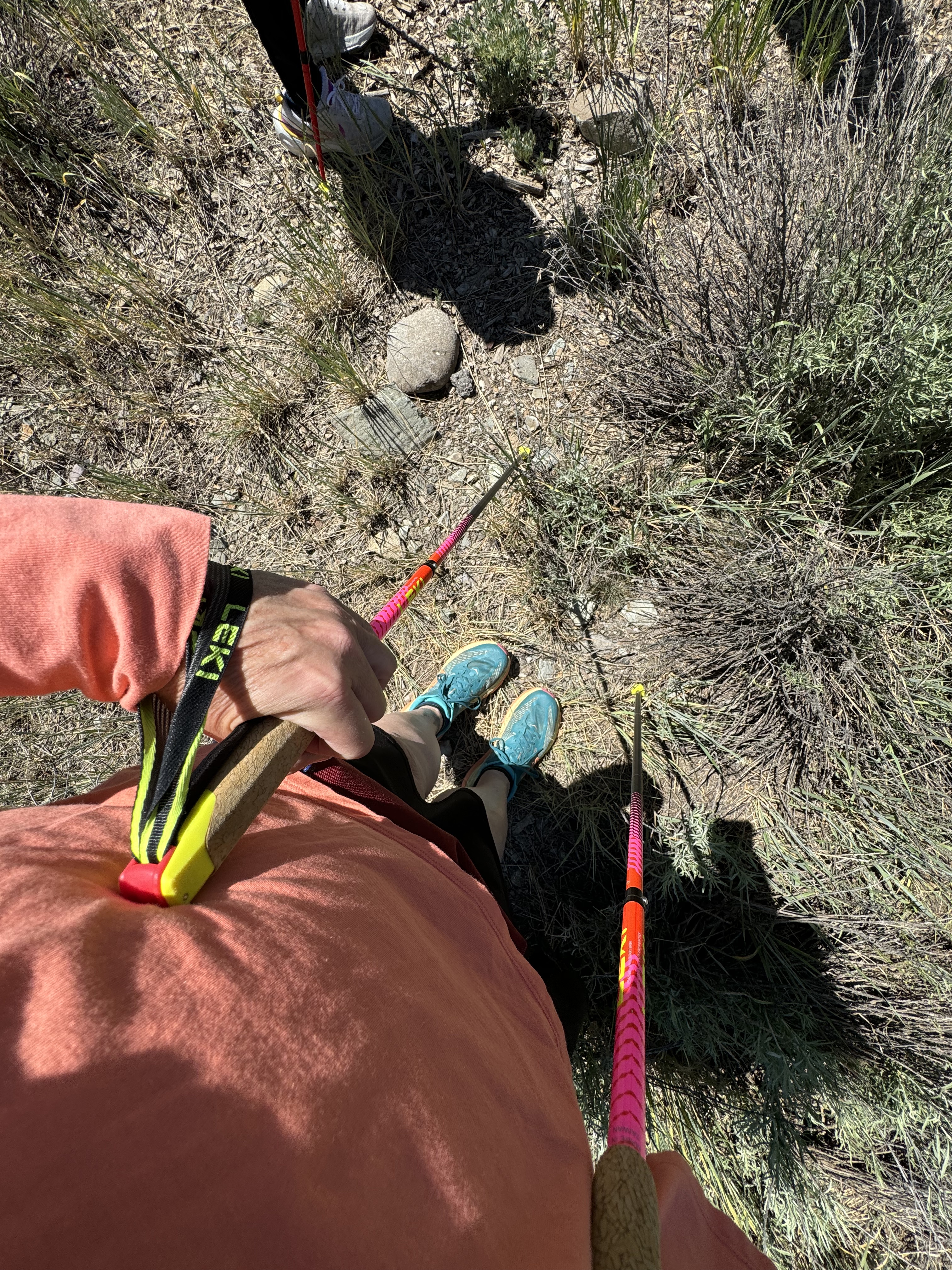
- Poles fit when your arms are holding the handles in front of you, with the tip of the pole right to the outside and front of each foot and elbows are bent at your side comfortably at a 90 degree angle.
- Think about maintaining roughly a ‘triangle’ shape to use the poles to the greatest advantage. Easiest to envision this when standing still. (*See picture at the bottom of this list!) Poles in front, shoulder width apart and if youre feet wee together both eet would be ONE point of the triangle. Eash pole serving as another point. I love my hip and know that stability — through my own work with strength and conditioning or in using trekking poles — is about ALL that matters for the longevity of this new hip.
- Trekking poles are like four-wheel drive! Two legs good. 4 legs (points of contact with the ground) BETTER! Imagine all the mountain animals you know that stick to the side of a rockface seemingly defying gravity and physics or rocket up a hill in powerful leaps and bounds to vanish out of site over the rim… They have FOUR legs and they’re using each and every single one of them. (I will now be channeling my inner mountain goat.)
- Using them uphill you can basically do one of three things/styles…
- Double pole — which is what some of the speedsters do on steep terrain. Using both poles slightly out in front and using them to push all the way off. Both at the same time in the front.
- Cadence – which is opposite pole/opposite foot planted JUST about where your foot is striking — not way out in front. Your arms WANT to work this way naturally — just go with it!
- My personal fav? Freestyle…. WHATEVER works. A combo of the above mentioned in whatever form/pattern/cadence style that works to help you go up the hill using your feet and the poles in ANY combination! DO WHAT WORKS and what feels natural!
- Downhill…
- Speedy and steady and have good balance? They’re gonna likely get in the way and you’d be better off stowing them and racing downhill.
- Slow, fatigued, need some balance help, late in a race, want to take some pressure off a lower extremity? Use them in front of you as a braking mechanism… Same options as mentioned above; double poles (MY FAV for downhill), cadence or freestyle…
- Note: I played with the options of coming downhill yesterday very much on purpose while this info was fresh in my noggin; I literally deloaded some of the stress and force OFF of my hip onto my chest/arms/poles. I could feel it! After practicing on a mile long 600 foot descent yesterday — MY ARMS ARE TIRED and my hip is NOT! Which means I was doing something right.
- Bonus? You can tell I am NOT a skier cause this is from the ski world and everyone else thought it was patently obvious… S-curve down the hill. You don’t have to go straight down the hill… (NOW they tell me!) So coming off a steep hill, turning gentle sweeping S-curves and using the poles… GAME CHANGER for me and my hip on the downhill! I was moving as fast and comfortably as I was PRE-hip-falling-apart!
- Etiquette. BE AWARE. Don’t trip fellow runners. Don’t stab volunteers. Don’t wave them around behind you as you run. They are a tool for you and yet can really, truly hurt others around you beyond just tripping them. Be aware and think about those around you. (I loved that in the teaching of technique and usage you could totally see Tim Tollefson the Race Director emerge for a flash as he talked about etiquette and thinking of other runners!)
I know there were more nuggets of wisdom. So much good stuff! Thank you Tim!
Happy trails! If you’ve got any questions or need encouragement to become a trekking pole user/fan — please do not hesitate to reach out! I’m learning right along with you and would be happy to share ideas or tips!
If you already use trekking poles for hiking and/or running, what tips did I miss that would be helpful for other beginners?!







 In search of mojo.

 all bets are off...